Skip to content

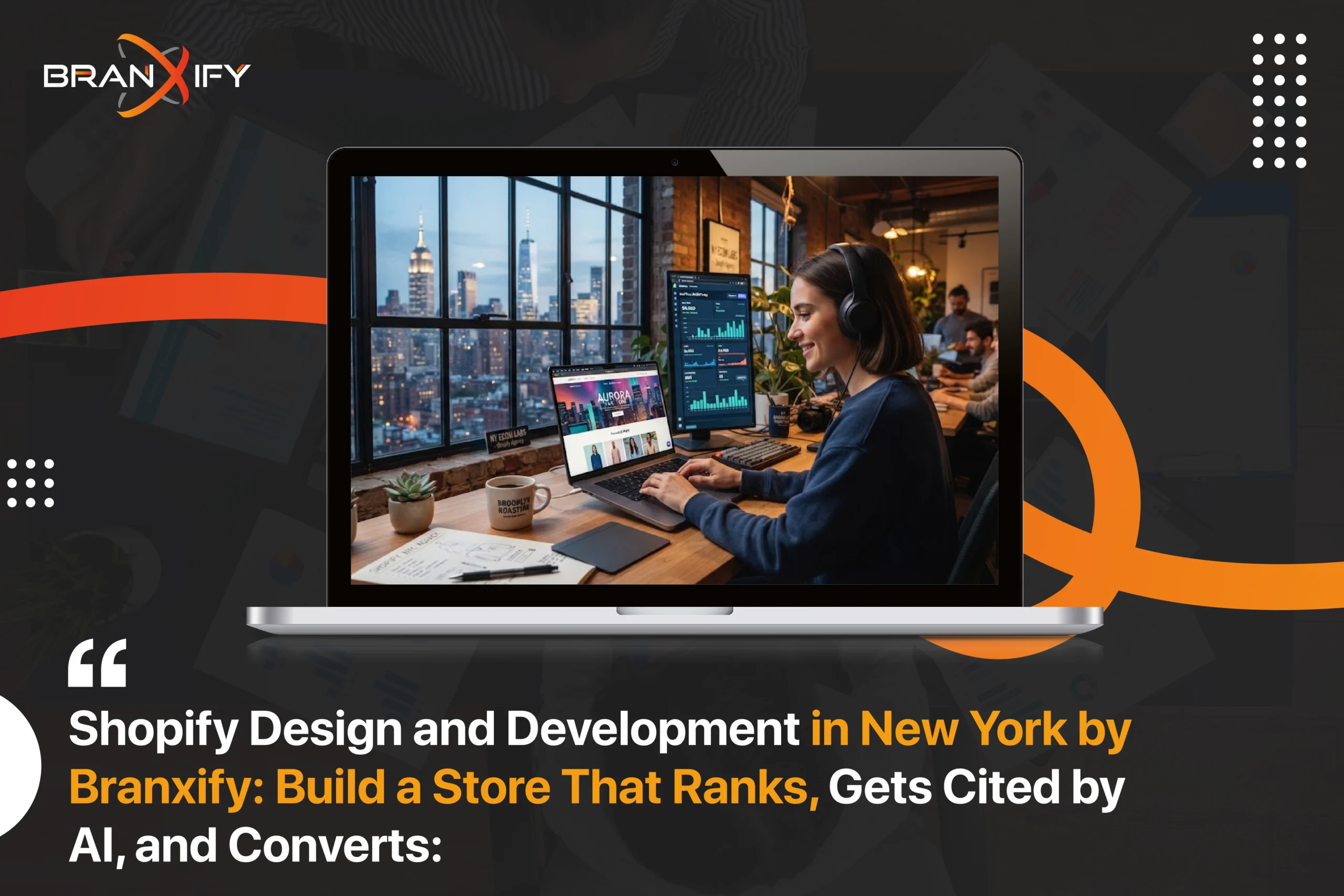
Shopify design and development is the process of planning, designing, and building a custom Shopify store around your brand, customers, and revenue goals. Branxify combines conversion rate optimization (CRO), search engine optimization (SEO), answer engine optimization (AEO), and generative engine optimization (GEO) into one build, so your store attracts traffic from Google and AI tools and turns that traffic into orders.
Many Shopify stores that look fine may still underperform. They load slowly, provide little useful information for AI assistants, and hide their best products. Visitors arrive but leave without making a purchase.
The cause is usually that design, development, and marketing are treated as separate jobs. A designer makes the store look good, a developer makes it work, and someone else “does the SEO.” By then, the templates are locked, the architecture is set, and fixing the store might cost more than building it properly in the first place.
Branxify offers Shopify design and development services in New York. Every line of code, piece of content, and layout is planned with one question in mind: Does this help the store get found, trusted, and bought from?
This guide covers what strong Shopify store development looks like in 2026, how AEO, SEO, GEO, and CRO fit together, and what it demands from any agency you hire.
Why is Shopify Design and Development in New York a Revenue Decision?

Your Shopify Website Development can be your best salesperson, working around the clock. Installing a theme and swapping in your logo cannot do the same job as a store built around how your customers shop.
Shopify design and development in New York matters commercially for four reasons:
- Speed Affects Sales: A slow page can lose shoppers before they see a single product.
- Structure Affects Rankings: Product, collection, and content organization determines whether search engines understand the catalog.
- UX Affects Conversions: Small friction points in navigation, checkout, and product pages compound into large revenue losses.
- Clarity affects AI visibility: AI tools recommend brands they can understand and verify.
Treating your store as an asset to be engineered, rather than a template to be decorated, changes what it earns.
The Four Growth Levers of Shopify Store Development: CRO, SEO, AEO, and GEO
These four Shopify store development disciplines are often confused, so here is what each one does and how they connect.
| Discipline | Full Name | What It Optimizes For | Primary Goal |
|---|---|---|---|
| Shopify Conversion Rate Optimization (CRO) | Conversion Rate Optimization | Visitors already on your site | Turn more visitors into buyers |
| Search Engine Optimization (SEO) | Search Engine Optimization | Google and Bing rankings | Earn organic traffic |
| Answer Engine Optimization (AEO) | Answer Engine Optimization | Featured snippets, voice search, and AI answers | Be the direct answer to a question |
| Generative Engine Optimization (GEO) | Generative Engine Optimization | ChatGPT, Gemini, Perplexity, and AI Overviews | Be cited and recommended by generative AI |
SEO, shopify answer engine optimisation (AEO) best practices, Shopify Generative Engine Optimization (GEO) bring the right people to your store.
Shopify Conversion Rate Optimization (CRO) helps turn those visitors into buyers. A store that is strong in only one of these disciplines leaks revenue somewhere.
Shopify Conversion Rate Optimization (CRO): Turning Traffic Into Revenue
Conversion rate optimization is the practice of improving a store so a higher percentage of visitors complete a purchase. Traffic is expensive, so raising the conversion rate is a fast route to growth. Two stores with identical traffic can generate different revenue because one converts better.
Where Shopify Website Design Loses Conversions
- Weak Product Pages: Thin descriptions, few images, and little supporting evidence give shoppers no good reason to trust you.
- Confusing Navigation: Shoppers who cannot find products in two or three clicks may leave.
- Slow Mobile Experiences: Most Shopify traffic is mobile; a desktop-first design can frustrate mobile shoppers.
- Friction at Cart and Checkout: Forced account creation, surprise shipping costs, and missing payment options can cause abandonment.
- Missing Trust Signals: Unclear return policies, a lack of security cues, and missing reviews can raise doubts at the worst moments.
How Branxify Builds Shopify Website Development for Conversion

- Product Pages That Sell: We lead with a clear value proposition, high-quality images and videos, benefit-driven copy, size and variant guidance, delivery estimates, and reviews near the buy button.
- Frictionless Mobile UX: We design for thumb-friendly navigation, with sticky add-to-cart buttons, simplified menus, and easy-to-use filters.
- Smart Merchandising: Bundles and recommendations increase average order value and enable cross-selling without pushing shoppers away.
- Streamlined Cart and Checkout: We support fast payment options like Shop Pay and Google Pay, show shipping thresholds early, and remove unnecessary steps.
- Continuous Testing: Launch is the start of optimization. We use heatmaps, analytics, A/B testing, and session recordings to find what improves results instead of relying on opinions.
SEO: Building a Shopify Store Google Can Understand and Rank

Shopify SEO services involve improving your store’s technical setup, authority, and content so it ranks for the searches your buyers make. Shopify Ecommerce Website Design gives you a solid foundation, but that foundation does not make your store rank on its own. Themes and default settings can leave many opportunities untapped.
Technical SEO: It is the foundation on which everything else sits. Branxify addresses:
- Site Architecture: A logical hierarchy from the homepage to collections to products, with clear internal linking so authority flows to commercially important pages.
- Duplicate Content Control: Shopify creates multiple URL paths for the same products. We manage canonical tags and collection structures so search engines can identify the authoritative versions.
- Core Web Vitals: Loading speed, visual stability, and interactivity can influence rankings and conversions. We minimise app bloat, implement image lazy loading, and reduce render-blocking scripts.
- Crawlability: Clean sitemaps, the resolution of orphan pages, and appropriate robots directives.
- Structured Data: Product, review, offer, breadcrumb, organisation, and FAQ schema help search engines interpret pages and support eligible rich results.
- Mobile-First Indexing: Google evaluates the mobile version of a site, so mobile quality matters for search visibility.
On-Page and Content SEO

- Keyword Mapping: Every collection and product targets a distinct search intent so pages do not compete with one another.
- Optimized Titles and Meta Descriptions: These are written to support search visibility and earn clicks.
- Collection Page Content: Collection pages can target valuable commercial keywords, but many stores leave them empty. We add useful content that helps search engines and shoppers.
- Product Descriptions: Original, benefit-led copy instead of copied manufacturer descriptions.
- Blog and guide content: Comparisons, how-to articles, and buying guides capture shoppers earlier in their research and build topical authority.
Why SEO Belongs in the Build?
Retrofitting SEO into a finished store is slow and expensive. Planning URL structures, schema, internal linking, and templates during the web design and development phase means the store is ready for search visibility at launch.
AEO: Becoming the Answer, Not Just a Result
Answer engine optimization is the practice of structuring your content so search engines, voice assistants, and AI tools can extract it as a direct answer to a question.
Searchers often want the answer itself rather than ten blue links. Featured snippets, People Also Ask boxes, and AI-generated summaries draw from pages that answer questions clearly.
What Makes Content Answer-Ready?
- Lead With The Answer: State the answer in the first one or two sentences under a question-style heading before adding depth.
- Use Question-Based Headings: A heading such as “How long does Shopify development take?” mirrors how people search.
- Keep Answers Concise and Self-Contained: A 40- to 60-word answer block is easier to extract than a long, meandering paragraph.
- Use Lists, Tables, and Steps: Structured formats are easy for engines to extract.
- Add FAQ sections with schema: Marking up FAQs helps engines identify paired questions and answers.
- Cover Follow-Up Questions: Anticipating the next question keeps your page useful and increases the number of queries it addresses.
AEO for E-commerce
For a Shopify store, AEO extends beyond blog posts. Product and collection pages can address the questions buyers ask before making a purchase, such as “Is this waterproof?”, “What size should I choose?” “How long does shipping take?”, and “Will this work with my device?” Branxify builds these answers into templates so every product page contributes to answer engine visibility.
GEO: Getting Recommended by AI Assistants
Generative engine optimisation is the practice of making your brand and content easy for AI systems like ChatGPT, Gemini, Perplexity, and Google’s AI Overviews to understand, trust, and cite.
Shoppers now ask AI tools questions like “What’s the best sustainable running shoe brand?” and “Which Shopify agency should I hire?” and act on the answers. If these systems do not know and trust your brand, you may be invisible in growing discovery channels.
How Generative Engines Choose What to Cite

AI systems tend to favor content that is:
- Clear and Factual: Specific information rather than vague marketing language.
- Well-structured: Organized with lists, headings, and defined terms.
- Authoritative: Supported by credible mentions, reviews, and consistent brand information across the web.
- Maintained and Fresh: Accurate details about pricing, availability, and policies.
- Semantically Rich: Covering a topic thoroughly rather than repeating one keyword.
How Branxify Builds GEO Into Your Store

- Entity Clarity: We make sure your brand, expertise, and products are described consistently across the site so AI systems can identify who you are and what you sell.
- Comprehensive Structured Data: Detailed schema gives machines unambiguous facts about products, reviews, and pricing.
- Answer-Rich Content: Pages that explain, compare, and define are easier to quote than pages built solely to sell.
- Review and Reputation Signals: Third-party reviews and mentions strengthen the trust signals AI systems weigh.
- Clean, Crawlable Code: Content buried behind heavy scripts can be harder for machines to read; we keep essential content accessible in HTML.
- Brand-Consistent Messaging: About pages, external profiles, and descriptions should tell the same story.
No one can guarantee placement in AI answers, as these change constantly. What you can control is whether your store gives these systems the information they need to recommend your brand with confidence.
How CRO, SEO, AEO, and GEO Work Together
These are stages of one customer journey:
Discovery: Shoppers ask Google or an AI assistant questions; AEO, GEO, and SEO influence whether your store appears.
Evaluation: Shoppers land on your store. Design, speed, clarity, and evidence shape their first impressions.
Decision: Persuasive product pages and trust signals encourage a purchase. This is CRO.
Purchase: A frictionless cart and checkout close the sale.
Retention: Email, post-purchase communication, and loyalty programs bring shoppers back and generate reviews, which feed back into SEO and GEO.
A gap at any stage costs you revenue. Branxify designs the whole loop rather than one piece of it.
The Branxify Shopify Design and Development Process

1. Discovery and Strategy
We study your brand, competitors, goals, analytics, and customers. This produces a clear picture of what you sell, what your customers search for, and where your store is losing money.
2. Information Architecture and SEO Planning
Before designing layouts, we map the site structure, keyword targets, internal linking, and collection hierarchy. This is where rankings are won or lost.
3. UX and UI Design
We design mobile-first, conversion-focused layouts that express your brand and guide shoppers toward a purchase. Every design decision has a purpose tied to the buying journey.
4. Shopify Development
We build custom themes and features with efficient code. This includes custom sections, headless builds, Shopify Plus solutions, and integrations where appropriate. Careful app selection keeps your store from becoming weighed down.
5. Content and Structured Data
We implement schema, optimize templates, and create answer-rich content designed for snippets, AI citations, and search visibility.
6. QA and Performance Testing
We test across browsers and devices, audit speed and Core Web Vitals, verify tracking, and check the purchase flow before launching.
7. Launch and Migration
For stores moving from one platform to another, we protect existing rankings with proper redirects, URL mapping, and post-launch monitoring.
8. Growth and Optimization
After launch, we track performance, run experiments, and refine the store. A store that improves each month outperforms one that was “finished” and left alone.
Custom Theme vs. Off-the-Shelf Theme
| Factor | Off-the-Shelf Theme | Custom Shopify Build by Branxify |
|---|---|---|
| Brand Differentiation | Looks like many other stores | Unique to your brand |
| Conversion Focus | Generic layouts | Built around your customer journey |
| Performance | Often includes unused features and code | Lean, purpose-built code |
| Seo And Schema | Basic defaults | Built into templates from day one |
| Scalability | Limited by theme constraints | Designed to grow with you |
| AI and Answer Readiness | Rarely considered | Planned into the structure and content |
Themes are a reasonable starting point for businesses testing an idea. Once you are spending real money on traffic, the cost of a generic experience can exceed the cost of a custom one.
Common Shopify Design and Development Mistakes That Quietly Cost You Sales
- Installing too many apps, which slows the store down.
- Copying manufacturer descriptions, which creates duplicate content and gives shoppers nothing new.
- Ignoring collection pages, which leaves valuable keywords unused.
- Designing for desktop and adjusting for mobile afterwards.
- Skipping structured data, which limits opportunities for rich results and machine understanding.
- Never testing, so decisions rest on opinion instead of data.
- Using vague brand messaging that neither shoppers nor AI tools can summarise.
- Every one of these mistakes is avoidable, and most are far cheaper to prevent than to repair.